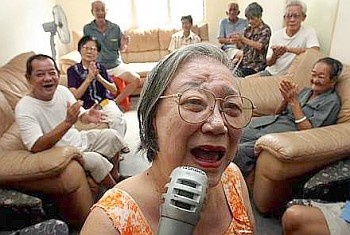
“Feliz Navidad” is playing at full volume. Staff and residents are crowded into the activity room. The microphone is passed around the room—karaoke style—as people take a turn singing along to the lyrics.
I wanna wish you a Merry Christmas, from the bottom of my heart.
A resident and his wife are arm in arm, swinging along with the music. A nurse takes the hand of a resident and twirls around the room. A resident is tapping his foot in his wheelchair.
Feliz Navidad, Feliz Navidad
This is a typical Wednesday afternoon at the long term care memory unit where I work.
If I asked the average American to imagine what a memory care unit looks like, it is unlikely that they would bring to mind the karaoke scene I described above. Many people assume such units are depressing or dismal. Some might even use hurtful and biased phrases like “the walking dead” or “an empty shell” to describe their residents. I often wonder how many of these opinions are formed due to misconceptions or simply lack of experience with people who live with dementia.
When we are too focused on loss, we neglect to see all the meaningful ways those with dementia can express themselves. A lot can be shared through a twinkle in the eye, laughter, a calm silence or a spirited story (even one you’ve heard before). As a geriatric psychologist, I am intimately aware of the suffering that progressive dementia causes for individuals and families. To recognize the possibility of joy does not discount that pain. When we accept that pain and joy can coexist, we make room for the full complexity of life.
The irony of dementia is that it traps someone in the present moment. The plaques, tangles, and atrophy of the brain often make thoughts of the recent past and future hazy. But to be fully present in the moment is to have access to a richer experience of now. Is this not what most of us strive for when we practice mindfulness or meditation?
Despite dementia-related losses, people continue to experience meaning in life in countless ways: while drinking a warm morning coffee, or watching the snow fall, for example, or while connecting with others by sharing stories of their childhood or holding the hand of a wife (or husband). Connecting with others does not require an intact memory. Connection does not even require the ability to verbally communicate. This reality challenges the one-dimensional, simplistic view that life is over the moment someone is diagnosed with dementia.
How often do you get to sing karaoke? How often do you dance with your friends? How often do you laugh until your belly hurts? For the residents who are living in the memory care unit where I work, the answer is, at least a few times a week.
I see so much life in long term care.

Anastasia Canell has a PhD in clinical geropsychology, a specialty that focuses on understanding and helping older people and their families. She has worked in hospitals, skilled nursing facilities and outpatient clinics, providing psychotherapy for individuals, groups and caregivers, and is currently employed as a dementia specialty care psychologist. She also does research and has written and spoken extensively about issues associated with aging, such as the way becoming an older person’s caregiver impacts young adults (18 to 25).