Does that change how you see me? It’s changed the way I see me. And, to my surprise, I like this me better.
In December 2025 I had major surgery to remove a benign brain tumor called an acoustic neuroma. The procedure worked, phew. It also severed my left acoustic nerve—so I’m deaf on that side–and my vestibular nerve, which helps with balance and spatial orientation.
I was what I dubbed “lurchy” well before brain surgery, and I still am.
I’ve done balance exercises for years, and I continue to. I’m perfectly steady on my pins but seldom able to manage stairs without touching a wall or the railing I’m always next to. I can walk at a good clip but have trouble toeing a completely straight line without a hand on someone’s elbow. Not to lean on, but for proprioception: a third data point that helps me orient my body in space.
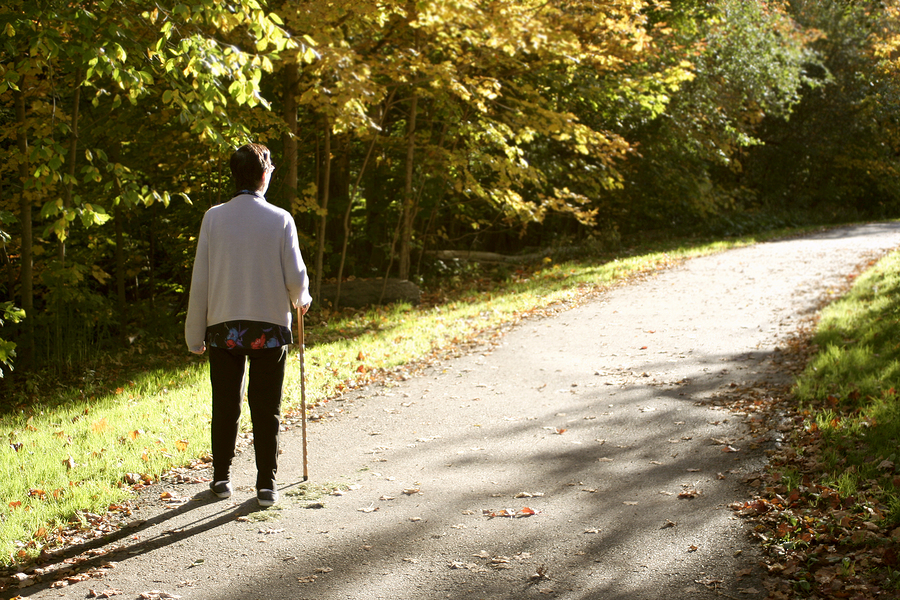
That’s what the cane provides. My partner, Bob, and I took two helpful lessons in How to Cane from David Wilson, a colleague and gifted movement coach. “Use as much as needed and as little as possible,” he advised. In other words, don’t lean on it unless you have to, and trust it when you do.
My partner took to his bright blue cane like a duck to water. It took me longer.
My top priority was preventing a fall. Therefore, I “reasoned” absurdly, I could hold off until the day I would otherwise have fallen! What was the real barrier? The long shadow cast by all those old-person-with-cane signs. Was I really ready to join their ranks? Ooof.
I was dismayed by my reluctance but I understood where it came from: my internalized bias—self-directed ageism and ableism—from seven decades living in a world that celebrates youth and speed and frames their loss as failure and betrayal. It was why I wasn’t surprised when a much younger friend stuck to crutches after foot surgery. Crutches signal “injured,” not “disabled.” The stigma is so powerful that many olders shun mobility aids, refusing to use walkers or wheelchairs even when it means never leaving home.
I figured using a cane would make me more cautious. It was the opposite.
I used to tense up a bit if the path narrowed or the sidewalk grew crowded. Now I’m more relaxed, which in itself makes me safer. (Ironically, fear of falling is a well-established risk factor for falls.)
That fear is rational, especially if, like me, you’ve taken quite a few tumbles. What makes the fear a barrier to aging well is when it limits movement instead of encouraging safer movement. Because I’m more confident, I take bigger steps. (Shuffling is a fall risk.) Because the cane informs me about what’s underfoot, I stand up straighter. (That reduces fall risk too. Heads are heavy, and hunching shifts our center of gravity forward.)
Do I do all these things all the time? Nope. Do I need a third hand when juggling phone, bag, bev, etc.? God, yes; I’m already clumsy. Do concerned friends ask, “What happened?” Yes, completely understandably. I hope my answer—“Nothing”—is food for thought. Do I still leave my cane at home? Occasionally, but I almost always return to grab it. Friends’ elbows are lovely. Feeling steady without them is liberating.
Five reasons I like using a cane:
- I can go places I otherwise wouldn’t, like Christmas-tree hunting in a Colorado state park. That snow was slippery.
- People give me more space.
- I’m more likely to get a seat on the subway. When Bob and I board together and look around, sometimes an entire bench empties, a covey of quail flushed by their consciences—almost always Latino men. It makes us smile.
- I’m walking the walk (pun intended), setting a proactive example for nondisabled friends and followers of all ages.
- If and when I can no longer walk without a cane, the transition will be shame-free.
That shame is a cultural failing, but it can feel like a personal one. It’s hard to overcome, but the benefits are very real. I understand this better now, intuitively and tactically. But I only recently learned of research showing that “patients who identify as disabled have less depression and anxiety, higher self-esteem, and a greater sense of ‘self-efficacy’”—that’s believing you can accomplish something—”than disabled people who don’t.”
That’s from a New York Times New Old Age column by Paula Span, “Wheelchair? Hearing Aids? Yes. ‘Disabled’? No Way.” The article bemoans the fact that so many older Americans with significant impairments forego assistance rather than identify as disabled. [They forego] not only what they’re legally entitled to, but things that would ease and expand their lives: helpful accommodations, better care, community.
Am I disabled? My friend Peter Fremlin, the editor of Disability Debrief, had a very helpful answer, obvious in hindsight: it’s not a binary. Most people could get along fine without a little finger, Peter pointed out, but not a professional pianist. I can hear fine in a quiet space, but not in a noisy restaurant. Context matters. So does the nature of an impairment, its onset and its duration. Identity is complicated and constantly evolving.
Whether or not I see myself as someone with a disability depends on the situation. Every time I head out with my cane, however, I look like one. I have indeed joined the ranks of the old-people-on-road-signs, and I’m good with that. Will some people assume I’m less engaged or engaging than the better-balanced? No doubt. That’s their loss, not mine.